30th EHA Congress Travel Award 受賞レポート 柴田 翔
 jsh-izawa
名前:柴田 翔【京都大学大学院医学研究科血液内科学】
発表形式:Oral
Title:
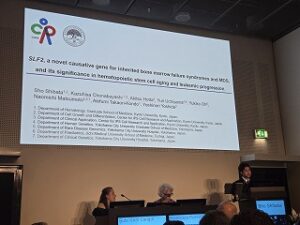
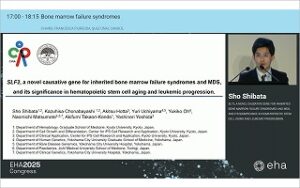
SLF2, a novel causative gene for inherited bone marrow failure syndromes and MDS, and its significance in hematopoietic stem cell aging and leukemic progression
Authors:
Sho Shibata1,2, Kazuhisa Chonabayashi1,2, Akitsu Hotta3, Yuri Uchiyama4,5, Yukiko Oh6, Naomichi Matsumoto4,5,7, Akifumi Takaori-Kondo1, Yoshinori Yoshida2
Affiliations:
1. Department of Hematology, Graduate School of Medicine, Kyoto University, Kyoto, Japan.
2. Department of Cell Growth and Differentiation, Center for iPS Cell Research and Application, Kyoto University, Kyoto, Japan.
3. Department of Clinical Application, Center for iPS Cell Research and Application, Kyoto University, Kyoto, Japan.
4. Department of Human Genetics, Yokohama City University Graduate School of Medicine, Yokohama, Japan.
5. Department of Rare Disease Genomics, Yokohama City University Hospital, Yokohama, Japan.
6. Department of Paediatrics, Jichi Medical University School of Medicine, Tochigi, Japan.
7. Department of Clinical Genetics, Yokohama City University Hospital, Yokohama, Japan.
Abstract:
Background: Inherited bone marrow failure syndromes (IBMFS) are a heterogeneous group of disorders caused by mutations in various genes. However, in some cases, the causative genes remain unidentified. Recently, pathogenic variants in SLF2 have been reported to cause a developmental disease: Atelis syndrome, characterized by hematological abnormalities, microcephaly, and short stature. However, the concept of Atelis syndrome remains poorly defined, and the mechanisms underlying its hematological abnormalities have yet to be clarified. SLF2 is known to play a role in DNA double-strand break repair, but its functions in hematopoietic cells remain unknown.
Significantly, incorporating a re-evaluation of Japanese cases, along with the cases from other countries, revealed that some exhibited dysplasia consistent with myelodysplastic syndromes (MDS) or MDS-like features. Additionally, our analysis of published data, showed that SLF2 expression is upregulated during aging in normal bone marrow hematopoietic stem cells (HSCs), suggesting that SLF2 plays a crucial role in the aging process.
Aims: We aimed to elucidate the mechanism underlying hematological abnormalities in Atelis syndrome and to reveal the role of SLF2 in hematopoietic cells and hematological malignancies.
Methods: We generated iPSC lines from a patient of Atelis syndrome carrying compound heterozygous variants in SLF2. For controls, we successfully corrected one of the mutated alleles using CRISPR-Cas9. These iPSC lines were differentiated into hematopoietic cells, and functional analyses were conducted. Additionally, an analysis of available public data was performed to investigate the role of SLF2 in acute myeloid leukemia (AML).
Results: Hematopoietic progenitor cells (HPCs) derived from patient-specific iPSCs showed reduced colony-forming capacity. Patient iPSC-derived HPCs exhibited impaired erythroid differentiation and erythroid dysplasia. Additionally, these HPCs demonstrated an increase in gamma-H2AX foci, indicating elevated DNA damage.
RNA sequencing of patient iPSC-derived HPCs revealed an exacerbated p53/p21 DNA damage response, reduced multilineage differentiation potential, myeloid priming, and increased cellular senescence. The analysis of publicly available data revealed that AML cases with lower SLF2 expression had a poor prognosis and a cellular senescence phenotype. These groups also demonstrated increased methylation around the transcription start site (TSS) of SLF2. Furthermore, these AML cases significantly harbored TP53 mutations.
Summary/Conclusion: SLF2 plays a critical role in maintaining HSCs through DNA repair, and SLF2 deficiency leads to the accumulation of DNA damage, driving the senescence of HSCs and ultimately contributing to the development of MDS. Our findings suggest that Atelis syndrome should be newly classified within the spectrum of IBMFS, and SLF2 should be recognized as a novel causative gene for IBMFS and MDS, warranting its inclusion in germline screening panels for IBMFS. On the other hand, SLF2 downregulation caused by acquired methylation similarly accelerates senescence and is associated with the prognosis of AML. Furthermore, within these processes, clonal evolution of TP53 mutations driven by selective pressure is suggested. These findings hold significant clinical implications for the diagnosis and treatment of IBMFS, MDS, and AML, while providing critical insights into the mechanisms underlying hematopoietic stem cell aging.
EHA2025参加レポート
この度JSH-EHA Travel Grant Program for EHA2025に採択を頂き誠にありがとうございました。EHA2025 Congressは私にとって初の国際学会参加であり、さらに自身の演題がoral presentationに採択されるという大変貴重な機会にも恵まれました。
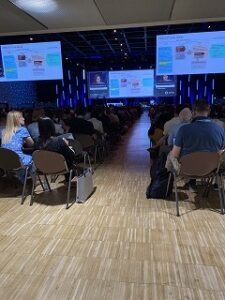
本年のEHAは、6月12日から15日までの4日間、イタリアのミラノで開催されました。ミラノは、芸術と歴史、そして現代的な都市機能が融合した魅力あふれる都市であり、世界中から多くの研究者が集まる国際会議の開催地としても非常にふさわしい場所であり、会場では最新の研究成果や臨床知見について活発な議論が交わされていました。セッション全体を通じて感じた事は質疑応答が非常に活発であり、根本的な姿勢からも学ぶべき所が多かったと思いました。
会期中にはYoung EHA Mixerという若手研究者向けの交流イベントにもご招待頂き、Travel Grantを受賞された他の日本人の先生方とも合流することができました。さらに、世界中の若手研究者とも直接意見を交わす貴重な機会となり、大きな刺激を受けました。
今回の学会参加を通じて、まさに自分が井の中の蛙であったことを痛感しました。世界の大きな潮流の中で、血液内科をバックグラウンドとする研究者として自分に何ができるのか、何をすべきなのかを改めて見つめ直す機会となり、将来の進路についても深く考えるきっかけとなりました。
私の発表に関しては、先天性骨髄不全症候群、そして骨髄異形成症候群に進展しうる新規の胚細胞遺伝子変異を報告した内容で、この遺伝子がそれらを引き起こすメカニズムをiPS細胞などを用いて解明した研究になります。原因不明の血液学的異常を呈している子供達の中にこの変異をもっている患者が存在していると考えられ、これらの知見を広め、血液疾患としての疾患概念を新たに確立し正確な診断に繋げる事、そして治療へと展開する事が私の研究の目標であります。
さらに本研究では、この遺伝子の後天的なメチル化による発現低下が、成人の急性骨髄性白血病の予後とも関連していることを明らかにしました。これらの所見は、腫瘍における多面的な異常の一側面を捉えたに過ぎないかもしれませんが、エピジェネティックな異常による遺伝子発現制御の破綻が腫瘍進展に関与することを示唆しており、白血病におけるより普遍的な病態理解や治療戦略の構築に貢献しうると考えています。
今回発表後に多くの方から質問、フィードバックを頂き、今後の研究の方向性を考える上でも非常に参考になりました。研究面での気づきに加えて、自分自身の課題にも向き合うことができ、非常に学びの多い機会となりました。この経験を胸に、より広い視野を持って、今後さらに研究に打ち込んでいく決意を新たにしました。
今回このような貴重な機会を与えていただきました日本血液学会事務局、ならびに国際委員会および賞等選考委員会の諸先生方、また日頃よりご指導いただいている蝶名林和久先生、吉田善紀先生、高折晃史先生、本研究に関わっていただいた全ての皆様に、この場を借りて厚く御礼申し上げます。また、日々私を支えてくれている大切な家族にも、この場を借りて深く感謝申し上げます。