30th EHA Congress Travel Award 受賞レポート 藤岡 真知子
 jsh-izawa
名前:藤岡 真知子【長崎大学大学院医歯薬学総合研究科 原爆・ヒバクシャ医療部門血液内科学研究分野】
発表形式:Poster
Title:
Outcomes of allogeneic transplantation for secondary myelodysplastic syndrome evolved from aplastic anemia and paroxysmal nocturnal hemoglobinuria
Authors:
Machiko Fujioka1,2, Yasushi Miyazaki2,3, Ken Ishiyama4, Noriko Doki5, Naoyuki Uchida6, Tetsuya Nishida7, Takahiro Fukuda8, Yuta Katayama9, Takeshi Maeda10, Hirohisa Nakamae11, Noboru Asada12, Keisuke Kataoka13,14, Koji Kawamura15, Junya Kanda16, Marie Ohbiki17, Yoshiko Atsuta17,18, Hidehiro Itonaga19
Affiliations:
1. Department of Hematology, Sasebo City General Hospital, Sasebo, Japan
2. Department of Hematology, Atomic Bomb Disease and Hibakusha Medicine Unit, Atomic Bomb Disease Institute, Nagasaki University, Nagasaki, Japan
3. Department of Hematology, Nagasaki University Hospital, Nagasaki, Japan
4. Department of Hematology, Center Hospital of the National Center for Global Health and Medicine, Tokyo, Japan.
5. Hematology Division, Tokyo Metropolitan Cancer and Infectious Diseases Center, Komagome Hospital, Tokyo, Japan
6. Department of Hematology, Federation of National Public Service Personnel Mutual Aid Associations TORANOMON HOSPITAL, Tokyo, Japan
7. Department of Hematology, Japanese Red Cross Aichi Medical Center Nagoya Daiichi Hospital, Nagoya, Japan
8. Department of Hematopoietic Stem Cell Transplantation, National Cancer Center Hospital, Tokyo, Japan
9. Department of Hematology, Hiroshima Red Cross Hospital & Atomic-bomb Survivors Hospital, Hiroshima, Japan
10. Department of Hematology and Oncology, Kurashiki Central Hospital, Kurashiki, Japan
11. Department of Hematology, Osaka Metropolitan University Hospital, Osaka, Japan
12. Department of Hematology and Oncology, Okayama University Hospital, Okayama, Japan
13. Division of Hematology, Department of Medicine, Keio University School of Medicine, Tokyo, Japan
14. Division of Molecular Oncology, National Cancer Center Research Institute, Tokyo, Japan
15. Division of Hematology and Clinical Laboratory Medicine, Department of Multidisciplinary Internal Medicine, Tottori University, Tottori, Japan
16. Department of Hematology, Graduate School of Medicine, Kyoto University, Kyoto, Japan
17. Japanese Data Center for Hematopoietic Cell Transplantation, Nagakute, Japan
18. Department of Registry Science for Transplant and Cellular Therapy, Aichi Medical University School of Medicine, Nagakute, Japan
19. Transfusion and Cell Therapy Unit, Nagasaki University Hospital, Nagasaki, Japan
Abstract:
Introduction: Acquired aplastic anemia (AA) and paroxysmal nocturnal hemoglobinuria (PNH) are pathogenically related non-malignant bone marrow failures linked to qualitative abnormalities of hematopoietic stem cell and T-cell-mediated autoimmunity. The incidence of secondary myelodysplastic syndrome (s-MDS) from AA and PNH was reported to be 4 to 10% by 10 years of follow-up. MDS represent a heterogenous group of myeloid neoplasms, and allogeneic hematopoietic stem cell transplantation (allo-HSCT) is regarded as the only potential curative treatment for MDS. However, limited data is available on the post-transplant outcomes of s-MDS. To clarify the role of allo-HSCT for s-MDS, we retrospectively conducted a nationwide retrospective study to compare the outcomes between s-MDS and de novo MDS (d-MDS).
Methods: This study included patients who were diagnosed with MDS according to the WHO classification. The clinical data of patients (i) who were 16-69 years old and (ii) who underwent their initial allo-HSCT between 2001 and 2022 were collected from the Transplant Registry Unified Management Program database. Patients with therapy-related MDS were not included in this study. Cox proportional hazards regression models were used to evaluate variables potentially affecting overall survival (OS). Fine and Gray proportional hazards models were used to evaluate variables potentially affecting cumulative incidences of relapse (CIR) and non-relapse mortality (NRM), using cumulative incidence curves to accommodate competing events.
Results: In this study, 83 and 5,566 patients were identified as the s-MDS and d-MDS groups, respectively. The median age at allo-HSCT was 48 years (range,16-69) and 56 (range,17-69) in the s-MDS and d-MDS groups, respectively. The s-MDS group was likely to (i) be younger at HSCT, (ii) have lower percentage of marrow blasts at HSCT, and (iii) have higher number of red blood cell (RBC) transfusion than the d-MDS group.
The 3-year OS were 76.3% and 52.4% (P<0.001); the 3-year CIR were 8.1% and 27.8% (P<0.001); and the 3-year NRM were 18.6% and 23.7% (P=0.464) in the s-MDS and d-MDS groups, respectively. The multivariate analyses revealed that the s-MDS group was associated with the better OS (HR, 0.45 [95% CI, 0.27–0.73]; P=0.002) and CIR (HR, 0.73 [95% CI, 0.61–0.89]; P=0.001) than the d-MDS group but no significant difference of NRM was observed between both groups.
To evaluate the prognostic impact of the disease-associated factors, we performed the analysis in the s-MDS group. The univariate analysis for OS showed no significant impact of marrow blast percentage at allo-HSCT (5-20%; P=0.857 and 20-30%; P=0.841) and cytogenetic risks (intermediate risk; P=0.243 and poor risk; P=0.562) in the s-MDS group. In the d-MDS group, the univariate and multivariate analyses for OS demonstrated significant impacts of these disease-related factors.
Conclusion: This study showed that the s-MDS groups significantly showed better OS and lower CIR than the d-MDS group. Furthermore, the poor disease-related factors (marrow blast percentage and cytogenetic risk) had less prognostic impact in the s-MDS group, suggesting that allo-HSCT would be a promising option for s-MDS patients with such poor factors. These findings would contribute to the development of therapeutic strategy for s-MDS patients.
EHA2025参加レポート
この度はJSH-EHA Travel Grant Program for EHA2025に選出いだき、EHA congress 2025への参加のご支援を賜り誠に感謝申し上げます。
EHA congress 2025はイタリア、ミラノで開催されました。ミラノは歴史的建造物が多く残る都市であり、街並み自体が歴史的な遺跡といえるような美しい都市でした。街を歩いていると日本語で話しかけられるようなとてもフレンドリーで温かい雰囲気に満ちていました。また、気候は日本よりも暑かったですが、その気候の暑さに負けないほど活発で情熱的な議論が交わされた学会でした。EHAは、臨床、基礎、教育に分かれて構成されており、また、欧州血液、骨髄移植学会、米国血液学会、国際血栓学会との合同シンポジウムも多数開催され、国際的かつ多角的な視点からの活発な議論が展開されておりました。また、Young EHA主催の「Young EHA Research Meeting」などを通じて、若手研究者による先進的な研究活動を拝聴することができ、大変刺激を受けました。さらに、「Young EHA mixer」では同じく受賞された先生方との交流の機会をいただき、同世代の先生方のご研究やご活動に触れ、新鮮な学びと感動がありました。
また、このような国際学会の醍醐味として発表前日にNew England Journal of Medicineに掲載されたHLA一致血縁者間における移植後シクロホスファミドによる移植片対宿主病予防の移植成績を現地で拝聴する機会にも恵まれました。特に、移植後シクロホスファミドによって、HLA適合度よりもドナー年齢や性別の組み合わせの重要性が相対的に高くなっているとする意見を拝聴し、次世代の移植医療の変革の最前線に触れることができました。
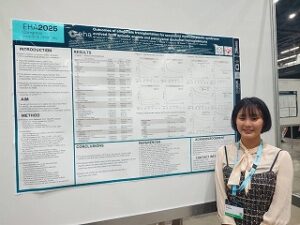
今回、私は「再生不良性貧血/夜間発作性ヘモグロビン尿症から移行した二次性骨髄異形成症候群(MDS)の移植成績」に関してポスター発表をいたしました。会場では活発に議論が交わされており、今回私の発表内容にも数多くの質問をいただき議論を深めることができました。今回の研究は日本造血細胞移植データセンターに登録された全国の移植症例のデータを扱わせていただきました。実際に臨床の現場で、再生不良性貧血からMDSに移行した症例を経験したことを契機に、具体的な移植成績や適切な移植前処置強度に関するエビデンスが乏しい現状を知ることとなり、今回二次性MDSの移植成績をまとめるに至りました。今回の移植成績のデータについては、全国で日々治療に励まれている患者さんとそのご家族の方々、患者さんと真摯に向き合われている先生方によって成り立っており、少しでも現場の疑問に答える一助となればと思い研究と向き合って参りました。今後も一臨床医として適切な医療を提供できるように日々の疑問を大切にし、患者さんの思いに応えていきたいと思います。
最後にEHA参加にあたり、サポートをいただきました日本血液学会国際委員会の先生方、事務局の皆様に感謝申し上げます。また、今回の発表の機会を与えてくださった長崎大学原爆後障害医療研究所 血液内科学分野 宮﨑泰司教授、長崎大学病院 細胞療法部 糸永英弘先生、快く長期出張に送りだしてくださった佐世保市総合医療センターの血液内科の先生方に深く感謝申し上げます。