30th EHA Congress Travel Award 受賞レポート 清水 夕貴
 jsh-izawa
名前:清水 夕貴【筑波大学大学院人間総合科学学術院医学学位プログラム】
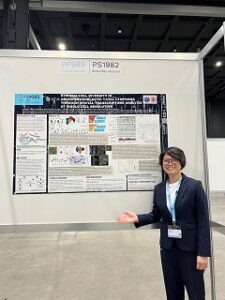
発表形式:Poster
Title:
Stromal cell diversity in angioimmunoblastic t-cell lymphoma through spatial transcriptome analysis at single cell resolution
Authors:
Yuki Shimizu1 Yoshiaki Abe2, 3 Kenichi Makishima3 Sakurako Suma3 Yasuhito Suehara2, 3 Keiichiro Hattori2, 3 Tatsuhiro Sakamoto2, 3 Daisuke Kaji4 Ayako Suzuki5 Kensuke Usuki6 Kosei Matsue7 Yasunori Ota8 Shigeru Chiba2 Yutaka Suzuki5 Mamiko Sakata-Yanagimoto1, 2, 3, 9
Affiliations:
1. Graduate School of Comprehensive Human Sciences, University of Tsukuba, Department of Hematology, Tsukuba, Japan
2. Institute of Medicine, University of Tsukuba, Department of Hematology, Tsukuba, Japan
3. University of Tsukuba Hospital, Department of Hematology, Tsukuba, Japan
4. Toranomon Hospital, Department of Hematology, Tokyo, Japan
5. Graduate School of Frontier Sciences, The University of Tokyo, Department of Computational Biology and Medical Sciences, Tokyo, Japan
6. Mizonokuchi Hospital, Teikyo University School of Medicine, Forth Department of Internal Medicine, Kawasaki, Japan
7. Kameda Medical Center, Division of Hematology/Oncology, Department of Internal Medicine, Kamogawa, Japan
8. The Institute of Medical Science, The University of Tokyo, Department of Pathology, Tokyo, Japan
9. Transborder Medical Research Center, University of Tsukuba, Division of Advanced Hemato-Oncology, Tsukuba, Japan
Abstract:
Background: Angioimmunoblastic T cell lymphoma (AITL) is a subtype of peripheral T-cell lymphoma, characterized by the proliferation of diverse stroma cells, including vascular endothelial cells and follicular dendritic cells. It is hypothesized that these stromal cells function as microenvironmental cells that support tumor cells. We previously reported that single-cell RNA sequencing (scRNA-seq) for stromal cells in lymph nodes (LNs) identified 30 distinct stromal cell subclusters (Nat Cell Biol, 2022). However, the specific stromal cell subclusters that contribute to the tumorigenesis of AITL have not yet to be identified.
Aims: We aimed to identify the heterogeneity of stromal cells in AITL microenvironments by employing singlecell RNA sequencing (scRNA-seq) and spatial transcriptomic (ST) analysis.
Methods: We sorted non-hematopoietic cells of LNs by magnetic cell sorting and fluorescence-activated cell sorting, and performed scRNA-seq on 10 AITL and 5 normal LNs. Then, based on the results of scRNA-seq, we designed a gene panel for ST on Xenium in situ consisting of 289 genes with the aim of detecting immune cells and stromal subclusters. Xenium in situ was subsequently performed on 27 formalin-fixed paraffinembedded samples of AITL. Finally, we performed whole exome sequencing (WES) on 27 AITL that had been analyzed with Xenium in situ.
Results: Firstly, we analyzed scRNA-seq data of 49,363 stroma cells. Unsupervised clustering and annotation based on canonical markers (UC-A) identified 10 blood endothelial cell (BEC) subclusters, 13 nonendothelial stromal cell (NESC) subclusters, and 7 lymphatic endothelial cell subclusters, consistent with the stromal subclusters reported in our previous report (Nat Cell Biol, 2022). We found that C-aHEVs, which expressed genes both capillary BECs and activated high endothelial venules (aHEVs), were separated into two subclusters. C-aHEV1 showed high expression of chemokines such as CXCL10 and CXCL12, while C-aHEV2 exhibited high expression of genes associated with extracellular matrix protein and leukocyte migration. Notably, both tip cells, which contribute to angiogenesis, and C-aHEV2 were increased in AITL.
Then, we analyzed ST data of 2,020,192 cells. UC-A identified 10 BEC subclusters, 5 NESC subclusters, and 8 immune and tumor cell subclusters. The measurement of minimum distance from tumor cells to each BEC subcluster revealed that C-aHEV1 was localized closer to tumor cells than any other BEC subcluster. Furthermore, niche analysis demonstrated that C-aHEV1, in combination with follicular dendritic cells, constituted a tumor niche. On the other hand, C-aHEV2 was localized farther from the tumor than CaHEV1, and was found to constitute an HEV niche in conjunction with other HEV subclusters. WES was successfully performed on 26 samples and G17V RHOA mutations were recurrently found in 19 samples. Of particular note, the number of C-aHEV2 cells per area was significantly higher in samples with G17V RHOA mutations than in those without.
Summary/Conclusion: Using scRNA-seq and ST data, we identified extracellular matrix protein-enriched C-aHEV2, which is increased in AITL, and cytokine-enriched C-aHEV1, which is localized near tumor cells. Further investigation is needed to elucidate the mechanisms by which these two HEV niches interact with tumor cells and promote tumorigenesis.
EHA2025参加レポート
この度はEHA2025参加にあたり、JSH-EHA Travel Grant Program for EHA2025に採択いただき誠にありがとうございました。
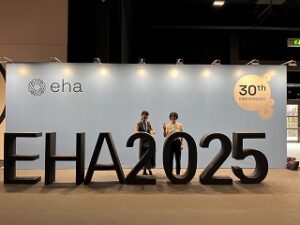
今年の開催地はイタリアのミラノで、約20時間の飛行機移動を終えてマルペンサ空港に降り立つと30度を超える気温と予想外の湿気で夏の陽気でした。移動には主に地下鉄を利用しましたが、学会で乗車券が配布されていたため会場周辺をスムーズに行き来することができ、合間にドゥオーモなどの観光にも気軽に足を伸ばすことができました。
今回が私にとって初の海外学会だったため初めは緊張しましたが、学会の雰囲気自体は日本血液学会総会と似ており安心しました。ポスター会場や企業ブースの規模は日本に比べると大きく感じ、ポスターを貼るボードの位置が高かったのも印象的でした。
基礎研究のセッションを集中的に拝聴し、特に悪性リンパ腫の腫瘍微小環境に関する講演は、私の研究テーマでもあるため最先端の解析手法や得られたデータの解釈など大変勉強になり、刺激的でした。ポスターセッションは2日目と3日目で入れ替えがあったためリアルタイムでは全ては見切れませんでしたが、空間解析に関する発表では解析方法について直接演者の先生に質問することができ、e-posterでもゆっくり閲覧することができたのが良かったです。
私は血管免疫芽球性T細胞リンパ腫 (AITL)の空間的トランスクリプトームデータの解析について発表をさせていただきました。AITLはT細胞リンパ腫の病型の一つであり、病理組織学的には血管や濾胞樹状細胞などの間質の増生が特徴とされておりますが、定量的な評価はなされておらず、またこれらの間質細胞の腫瘍微小環境における意義も明らかになってはおりません。私達の研究室では正常リンパ節の間質細胞に関するシングルセルRNAシーケンスによって発現遺伝子のパターンに基づき間質細胞が血管内皮細胞サブクラスタ10個を含む30個のサブクラスタに分類できることを報告しております。今回はシングルセルRNAシーケンスによってAITLで増加している血管内皮細胞サブクラスタの同定し、各間質細胞サブクラスタと免疫細胞サブクラスタのトップマーカーを抽出して空間的トランスクリプトミクスのための遺伝子パネルを設計しました。次にこの遺伝子パネルを用いて一細胞レベルでの空間的トランスクリプトミクスを実行し、各血管内皮サブクラスタと腫瘍細胞の位置関係を定量的に解析し、腫瘍細胞の間ではたらく相互作用分子の候補について報告いたしました。今後はこれらの解析結果を細胞を用いた実験で検証し、予後との関連や新たな治療標的の探索を行いたいと考えております。
最後になりますが、今回このような貴重な機会を与えて下さった日本血液学会国際委員の先生方と多大なサポートをいただいた事務局の皆様に感謝申し上げます。また日頃より研究のご指導をいただいております坂田麻実子先生に心より御礼申し上げます。